This in-depth Perforce vs SVN (Subversion) comparison analyzes the technical and financial trade-offs between the industry's two leading centralized version control systems.
George Neguceanu
11 Mar 2026
Updated on
12 Mar 2026
5
min read
Content
In the world of version control, centralized systems remain the backbone of many enterprise environments, where strict control and massive repositories are standard. When evaluating Perforce vs SVN, organizations are choosing between a professional-grade, high-performance engine and a reliable open-source solution.
TL;DR
Perforce: Built for high performance, massive binary files, and complex enterprise scaling. This commercial product excels in the game development and large-scale asset production industries.
SVN (Subversion): An open-source system that is mature, easy to set up, and ideal for small to midsized teams. Although it offers a simpler learning curve, it lacks the raw speed and advanced feature set of Perforce.
Performance and scale
In the Perforce vs SVN performance race, Perforce is the clear winner for large-scale operations. It is designed to handle repositories containing millions of files and petabytes of data with minimal latency.
SVN is generally reliable for medium-sized projects. However, because it manages metadata in a way that requires frequent communication with the server for basic operations, SVN can feel sluggish compared to Perforce when working with the massive, deeply nested folder structures that are common in game engines like Unreal or Unity.
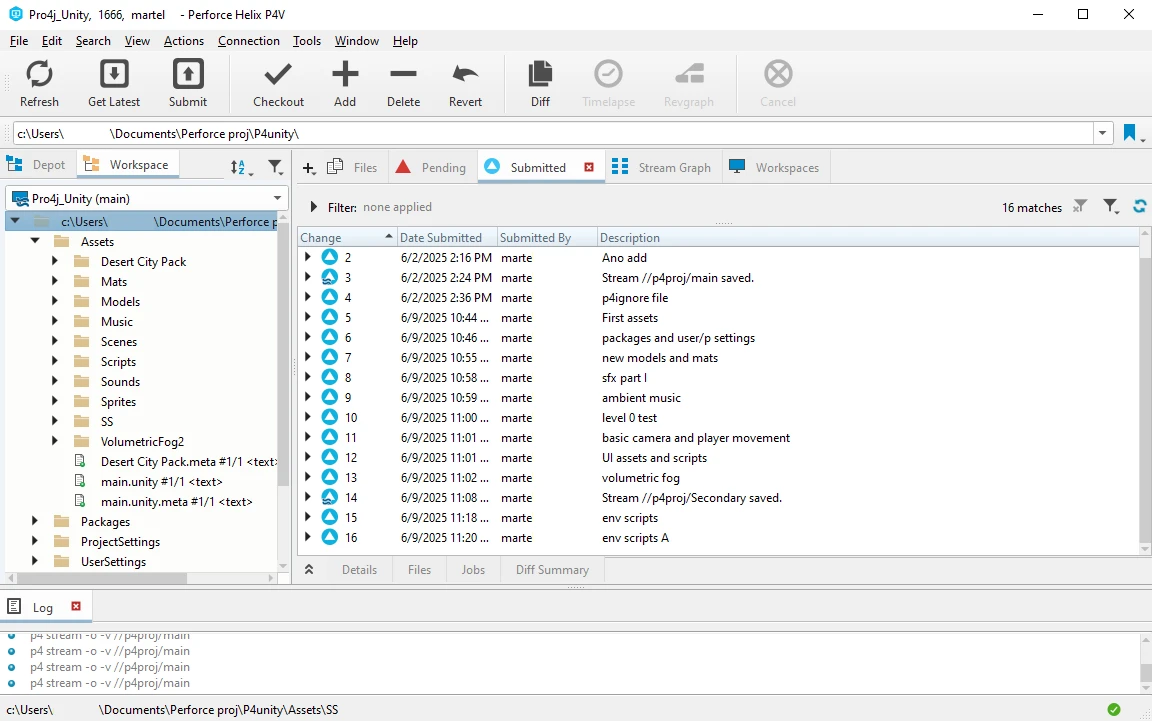
An Unity project managed with Perforce P4 client.
Binary handling and File Locking
For artists and non-technical team members, version control is essentially about "file distribution" and "communicating completed tasks." Since binary files, such as textures or 3D models, cannot be merged like code, both systems use exclusive locking..
Perforce: Automatically prompts users to "check out" a file, preventing others from editing it simultaneously.
SVN: Supports "svn lock," but it is often a manual step that is easier for users to forget, leading to potential "out-of-sync" errors.
Branching models: Streams vs. Directories
Branching is like making a "checkpoint" for your project to test new features without breaking the main build.
Perforce Streams: A specialized "guided" branching model. It visualizes the flow of code and assets, making it easier for leads to manage how updates move from "Dev" to "Main" to "Release."
SVN Branching:SVN treats branches as simple directories. While flexible, it lacks the built-in logic and visualization of Perforce, often requiring more manual overhead to track where a specific fix originated.
Permissions and security
Decision-makers and large companies often prioritize data security.
Perforce offers granular permissions. You can restrict access to a single file within a folder, which is vital when working with external contractors who should only see specific assets.
SVN typically handles permissions at the directory level. This is often "good enough" for internal teams but requires more complex server configuration for fine-grained security.
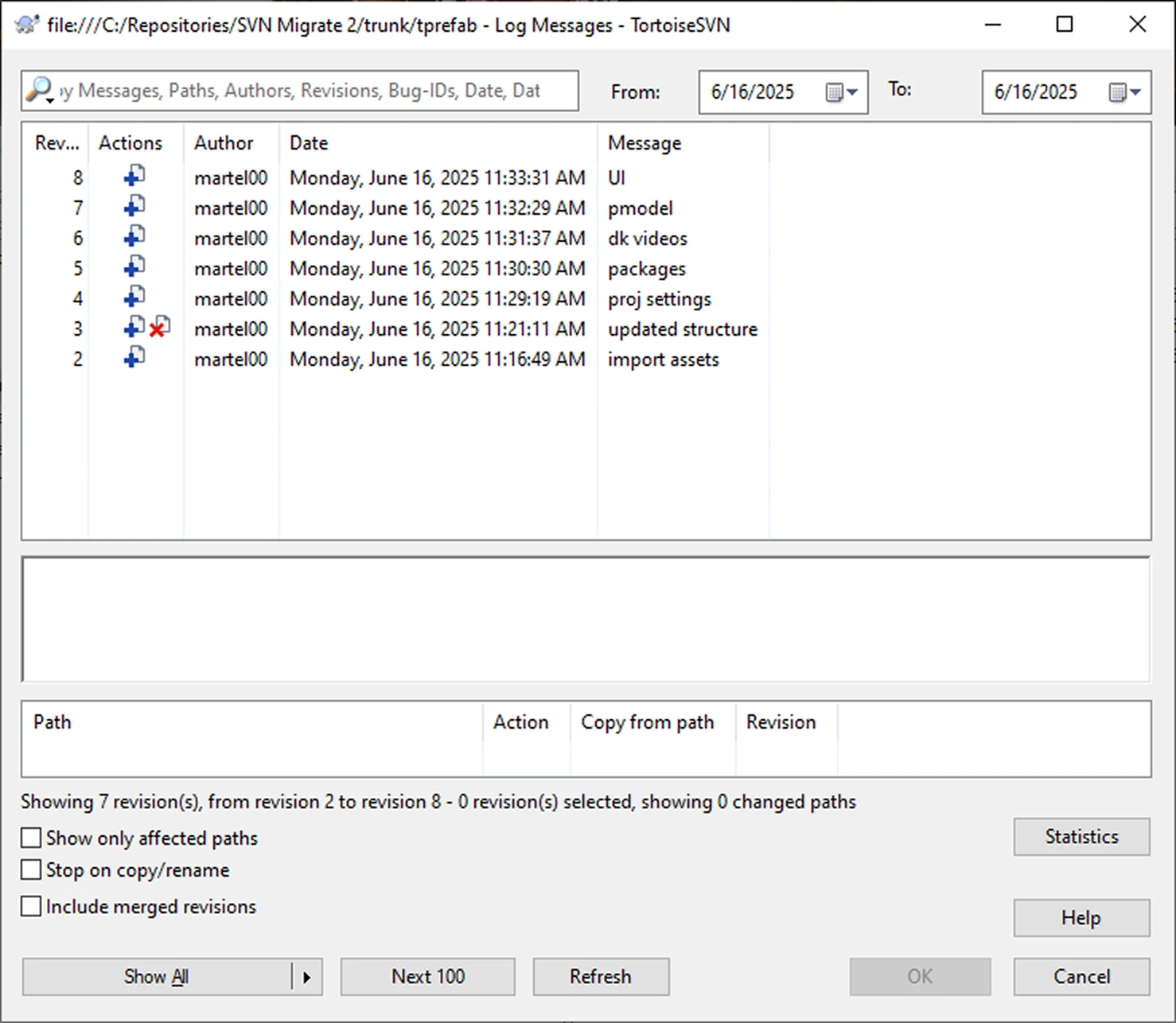
An Unity project managed with Tortoise SVN client.
Cost analysis
The most significant differentiator in Perforce vs SVN is the price tag.
SVN is open-source and free. Your only costs are server hosting (Assembla starts at 5.39$ per user/month) and the "man-hours" required for maintenance.
Perforce is a premium product. While it is free for small teams (up to 5 users), it becomes a significant budget item as you scale. Leads must weigh the license cost against the time saved by Perforce’s superior performance.
Migration notes: Moving between systems
If your team is outgrowing SVN, migrating to Perforce is a common path. Most migration tools allow you to keep your commit history, though the "branching" metadata often requires manual cleanup.
Migrate SVN to Perforce
To migrate a project from Subversion (SVN) to Perforce, you can use p4convert-svn, a Java utility supplied by Perforce that imports SVN history by reading an SVN dump file, or svn2p4, a Perl script created by Perforce users Vitalii Pokrovskii and Mark Fridrich that uses a "sync-and-replay" method. It checks out each SVN revision locally, translates it into a Perforce change, and submits it.
Migrate Perforce to SVN
To migrate from Perforce to SVN, you can use p42svn, a Perl script developed by Ray Miller that is designed to convert Perforce repositories to SVN format while preserving history. Another option is to use Git as an intermediary with the command git p4 clone.
Conversely, many teams are moving away from legacy centralized systems and toward Git-based workflows. Although Git was historically challenging for artists, solutions like Anchorpoint, a version control system compatible with Git, now offer the "simple guidance" that non-technical users require. Anchorpoint allows artists to use Git with a simplified user interface (UI), automatically handling file locking and large binaries (LFS), and effectively bridges the gap between SVN's simplicity and Perforce's power.
The Git-based alternative to P4
Perforce P4 (formerly Helix Core) is the industry standard for AAA games, but it is expensive and requires significant administrative overhead. Anchorpoint offers the same essential game development features, such as file locking and binary asset management, built on a modern Git-based workflow that artists enjoy using.
Pick Perforce if: You are a growing studio with 20+ members, handling massive Unreal Engine projects, and need the absolute best performance and security.
Pick SVN if: You are an indie team or an educational institution with a low budget for tools and your project size remains manageable.
FAQ
Is Perforce better than SVN for game development?
Generally, yes. Perforce is optimized for the large binary files and complex branching structures found in game development. However, for very small teams, SVN's low hosting price point is a strong counter-argument.
Does SVN support file locking like Perforce?
Yes, SVN supports exclusive locking. However, Perforce’s "check-out" workflow is more deeply integrated into its client tools, making it harder for artists to accidentally skip the locking step.
Can I use Anchorpoint with Perforce or SVN?
No. Anchorpoint is a version control solution built specifically to be 100% compatible with Git. It provides a Perforce-like experience (file locking, easy UI) but runs on Git infrastructure like GitHub or GitLab.
Why is Perforce the industry standard for AAA?
Mainly due to its ability to handle millions of files and its "Streams" feature, which simplifies the massive complexity of managing multiple versions of a game simultaneously.
How hard is it to learn Perforce vs SVN?
Both have a learning curve. SVN is simpler because it acts like a basic file system with history. Perforce is more powerful but requires users to understand concepts like "Workspaces" and "Changelists."